
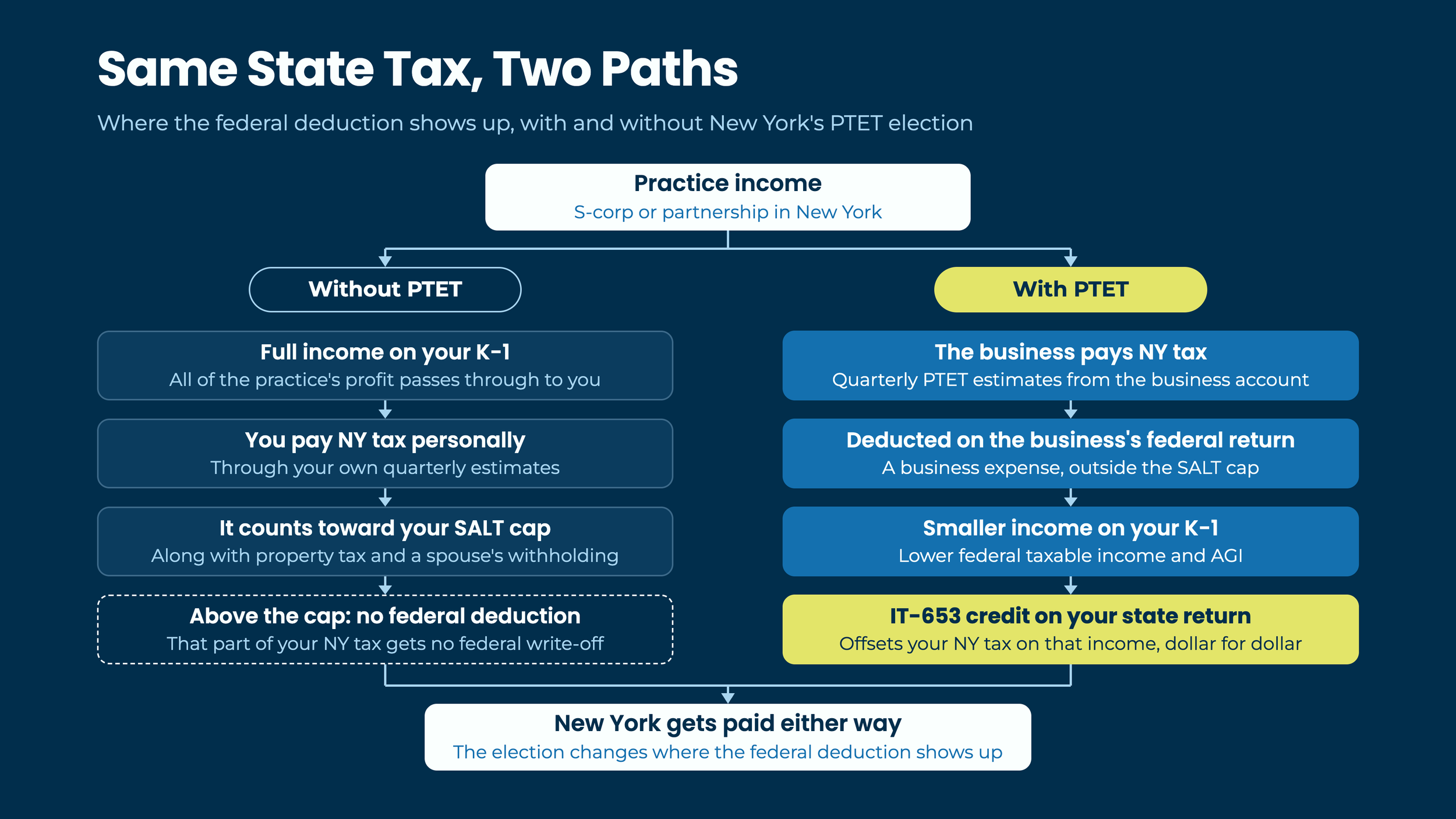
If your practice runs through an S-corp or partnership in New York, you already pay state income tax on what it earns. Usually that money leaves your personal account as quarterly estimates. New York lets the business make that same payment instead, and when it does, the business can deduct it on its federal return.
That deduction falls outside the SALT cap, the federal limit on how much state and local tax you can write off personally. The cap keeps moving: $10,000 starting in 2018, $40,000 for 2025, rising 1% a year to $40,804 for 2027, and scheduled to drop back to $10,000 in 2030. It also shrinks for owners with income above $510,050 in 2027. For a New York City practice owner paying state income tax, city income tax and property tax, the cap fills up fast.
The election is called the pass-through entity tax, or PTET. Most business owners I talk with have never heard of it; it usually comes up because I bring it up. A therapist, an acupuncturist, a psychiatrist in solo practice: you're paying the state tax either way. The election decides whether a federal deduction comes with it. For tax year 2027, you have until March 15, 2027 to choose.
How the federal savings work?
Once the business elects PTET, it pays New York tax on its income. On the federal return, that payment counts as a business expense, so the income on your K-1 drops by the same amount. You then claim a New York credit for your share of what the business paid (Form IT-653, filed with your state return), and it offsets your state income tax on that income dollar for dollar.
New York collects about what it would have anyway. Your federal return shows less income, because the IRS treats the payment as a cost of running the business (it said so in Notice 2020-75). The SALT cap limits state and local taxes you deduct personally. It doesn't apply to business expenses.
Lower K-1 income also means a lower AGI. That can help owners near the $510,050 line where the SALT cap starts to shrink, and it can help with other parts of the return that depend on income.
Ugh… The paperwork
PTET adds work, and it repeats every year. The business opts in online with New York by March 15. If it misses that date, the option is gone until the next tax year. After electing, the business makes quarterly estimated payments on March 15, June 15, September 15 and December 15, so the first payment is due the same day as the election. It also files a separate PTET return and gives each owner what they need to claim the credit.
New York City has its own PTET, elected in the same New York State online account by the same March 15 deadline, with city estimates entered on their own line next to the state ones. Who qualifies depends on the entity. A partnership can elect it if at least one partner lives in the city. An S-corp can elect it only if every shareholder lives in the city, which a solo practice owner in Brooklyn or Manhattan meets automatically.
The timing has to work between your business and your personal return. Once the business is paying the state tax, your personal estimates should come down. Otherwise you pay New York twice in the same year and wait for a refund. Your CPA runs the numbers, and it's worth having that conversation before March, not in April.
Why specialized practices should look at this?
Federal tax law has a category called "specified service trade or business." It includes health, law, accounting, consulting and other fields where the owner's skill is what the business sells. Therapists, acupuncturists and psychiatrists usually fall into it.
When the 2025 tax law was being written, the House version would have barred these practices from using PTET. The final law dropped that restriction, so they still qualify.
There's one tradeoff to know about. The QBI deduction lets some owners deduct up to 20% of their business income, and for specified service businesses it phases out at higher incomes. PTET lowers business income, which can shrink QBI for owners who still get it. Owners whose income already puts them past the QBI phase-out don't face that tradeoff, so PTET is often a cleaner decision for them.
Two incomes in New York City
Example: one spouse earns a high W-2 salary, and the other runs a therapy practice through an S-corp. They live in the city and file jointly.
The $510,050 income line where the SALT cap starts to shrink is the same for a married couple as for a single filer. With two incomes on one return, many NYC couples cross it, and their cap slides back toward the $10,000 floor. The W-2 spouse's state and city withholding plus property tax can use up that $10,000 on its own, so whatever the practice owes New York on top of that gets no federal deduction.
PTET moves the practice's state and city tax onto the business return, where the cap doesn't apply. That same joint income usually puts the therapist past the QBI phase-out, so the tradeoff from the last section doesn't apply either. This is the household where the election tends to do the most good.
Do it Before March 15
A tax return looks back at a year that's already over. PTET has to be decided by March 15, before most of the year's income is earned. That makes it a planning decision, and it touches the whole household at once: the practice's cash flow, your personal estimates, a spouse's withholding if you file jointly, and the QBI tradeoff.
I set up PTET for my wife Margarita's pediatric mental health practice for 2026, and projecting was the hard part. You're estimating a full year of practice income, a spouse's pay and where the federal thresholds land, all before spring. I use a calculator I built for this, and it gets us to a solid best estimate. It's still an estimate, so we adjust the payments as the year fills in.
Even with that uncertainty, I think PTET is worth looking into if your practice runs through an S-corp or partnership. The election itself is a short online filing, and many CPAs leave it to the business owner to make. I walk my clients through it when they want the help. The planning comes first: looking at the year you expect, deciding whether the election fits it, and setting the payments around it. Having that conversation this fall leaves room to decide. In April it's too late for 2027.
The information shared in this article is intended only to provide general financial education, for informational purposes only. The information and opinions within should not be regarded as objective facts. The publisher cannot guarantee that content is accurate and updated to reflect changes in legislation, financial data, or opinion.
This content does not provide financial, tax, legal, or any professional advice. Personal financial decisions should not be implemented based on the content of this site. Do not act upon any information without first consulting a licensed investment, tax, or legal professional.
Igor Aronov, the publisher of this content, is a registered investment adviser representative and owner of FAR Financial Inc.